Diesel in Finland hit a record €2.49 a litre in October, up 55% in a year, according to Statistics Finland. In the European Commission’s figures for 16 November it was the most expensive in the EU, at €2.56. Finland has also just raised its tax-free mileage rate for 2027 to 58 cents per km.
A mileage rate doesn’t tell you what driving costs, though. It’s pitched at the costs of an employee’s own car. It doesn’t cover the driver’s time, and it doesn’t match what a company van or truck really costs to run. This article compares mileage rates and diesel prices in five European countries, works out what a driven kilometre really costs, and puts a figure on what wasted kilometres cost in a year.
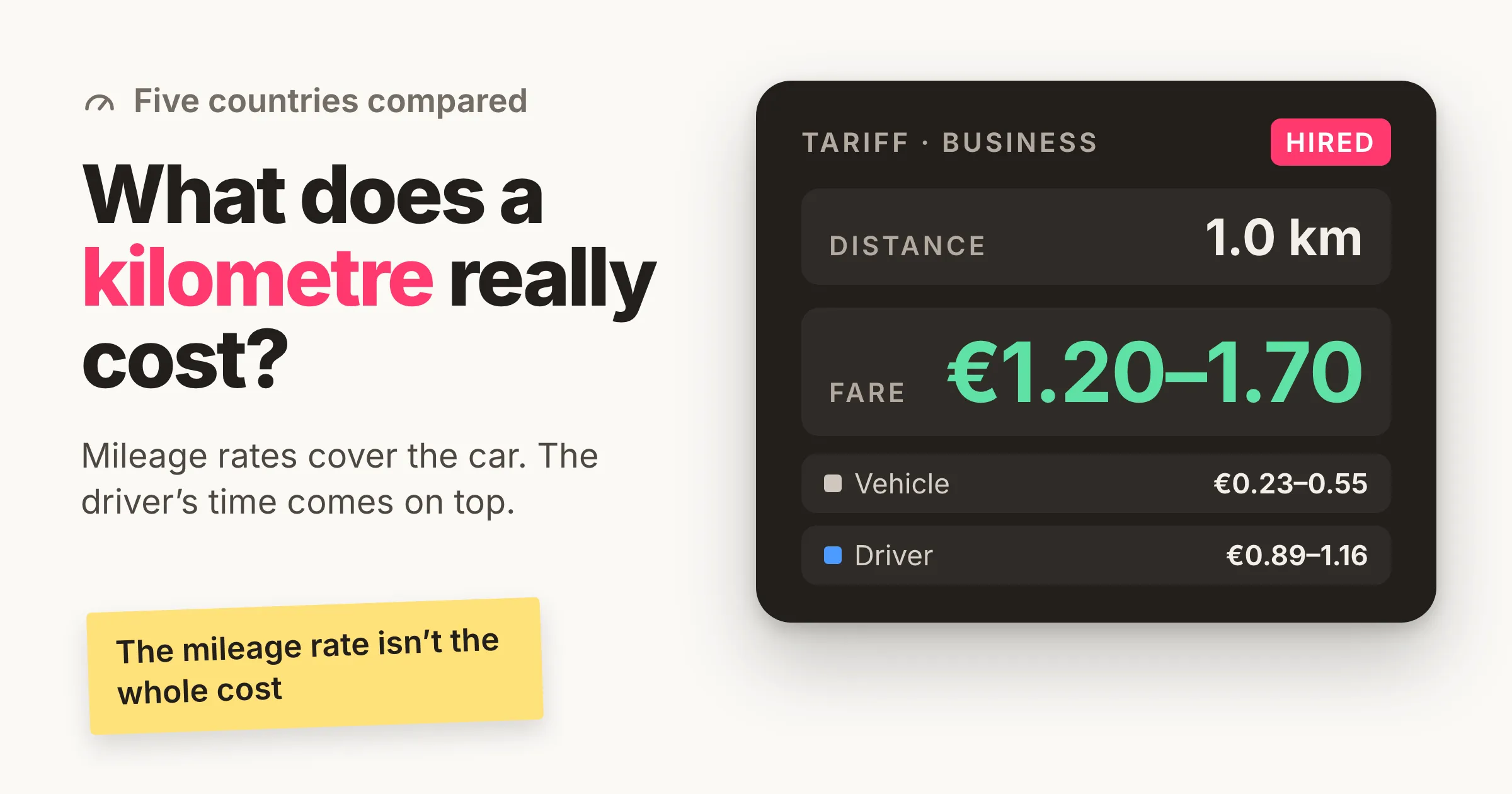
Mileage rates in five countries
Each country sets a tax-free rate per kilometre that an employer can pay when an employee drives their own car for work. The rates for 2026 differ by more than a factor of two.
| Country | €/km, 2026 | Rate and notes |
|---|---|---|
| Finland | 0.55 | €0.55 per km; €0.58 in 2027 |
| Denmark | 0.53 | DKK 3.94 per km for the first 20,000 km a year, DKK 2.28 (€0.31) above that |
| Germany | 0.30 | €0.30 per km, a flat rate for business trips; documented actual costs can be reimbursed instead |
| Netherlands | 0.25 | €0.25 per km, raised mid-year from €0.23 and backdated to 1 January 2026; covers commuting and any means of transport |
| Sweden | 0.23 | SEK 25 per mil (10 km); the 2027 rate was not published at the time of writing |
SEK and DKK are converted at the European Central Bank’s reference rates of 17 November 2026. The UK isn’t included, because the EU price and labour-cost data used below don’t cover it.
When the vehicle belongs to the company, the full rate doesn’t apply. Finland and Sweden allow only a small tax-free amount when an employee with a company car pays its fuel: 11 cents per km in Finland in 2026, and SEK 12 per mil in Sweden. Otherwise the company books the vehicle’s actual costs, and the cost per kilometre has to be worked out from them.
Diesel prices in five countries
The European Commission publishes average pump prices for every EU country each week. On 16 November 2026, Finland had the most expensive diesel in the EU and Sweden the cheapest of these five.
| Country | Diesel, €/l | Fuel per km, van at 9 l/100 km |
|---|---|---|
| Finland | 2.56 | €0.23 |
| Denmark | 2.37 | €0.21 |
| Netherlands | 2.29 | €0.21 |
| Germany | 2.22 | €0.20 |
| Sweden | 1.91 | €0.17 |
| EU weighted average | 2.05 | €0.18 |
The fuel gap between the cheapest and the most expensive of these countries is only about 6 cents per kilometre for a van. In Sweden and the Netherlands, the tax-free rate covers little more than a van’s diesel. The rates are set for cars: at 6 litres per 100 km, a car burns €0.11–0.15 of diesel per kilometre at these prices. Anyone running vans shouldn’t mistake the mileage rate for their cost.
The part no mileage rate covers: the driver’s time
In field work, the person at the wheel is a paid technician. On one of our customers’ service days in Finland, the team drove 613.2 km in 13.8 hours, an average of 44.4 km/h. Every kilometre took about 1.4 minutes of paid time.
Eurostat publishes the average hourly labour cost for every EU country: wages plus the employer’s social contributions and other labour costs. Divide it by 44.4 km/h and you get what the driver’s time costs per kilometre.
| Country | Total, €/km | Driver’s time, €/km | Mileage rate, €/km | Labour cost, €/h (2025) |
|---|---|---|---|---|
| Denmark | 1.69 | 1.16 | 0.53 | 51.7 |
| Finland | 1.44 | 0.89 | 0.55 | 39.4 |
| Netherlands | 1.33 | 1.08 | 0.25 | 47.9 |
| Germany | 1.31 | 1.01 | 0.30 | 45.0 |
| Sweden | 1.20 | 0.97 | 0.23 | 43.1 |
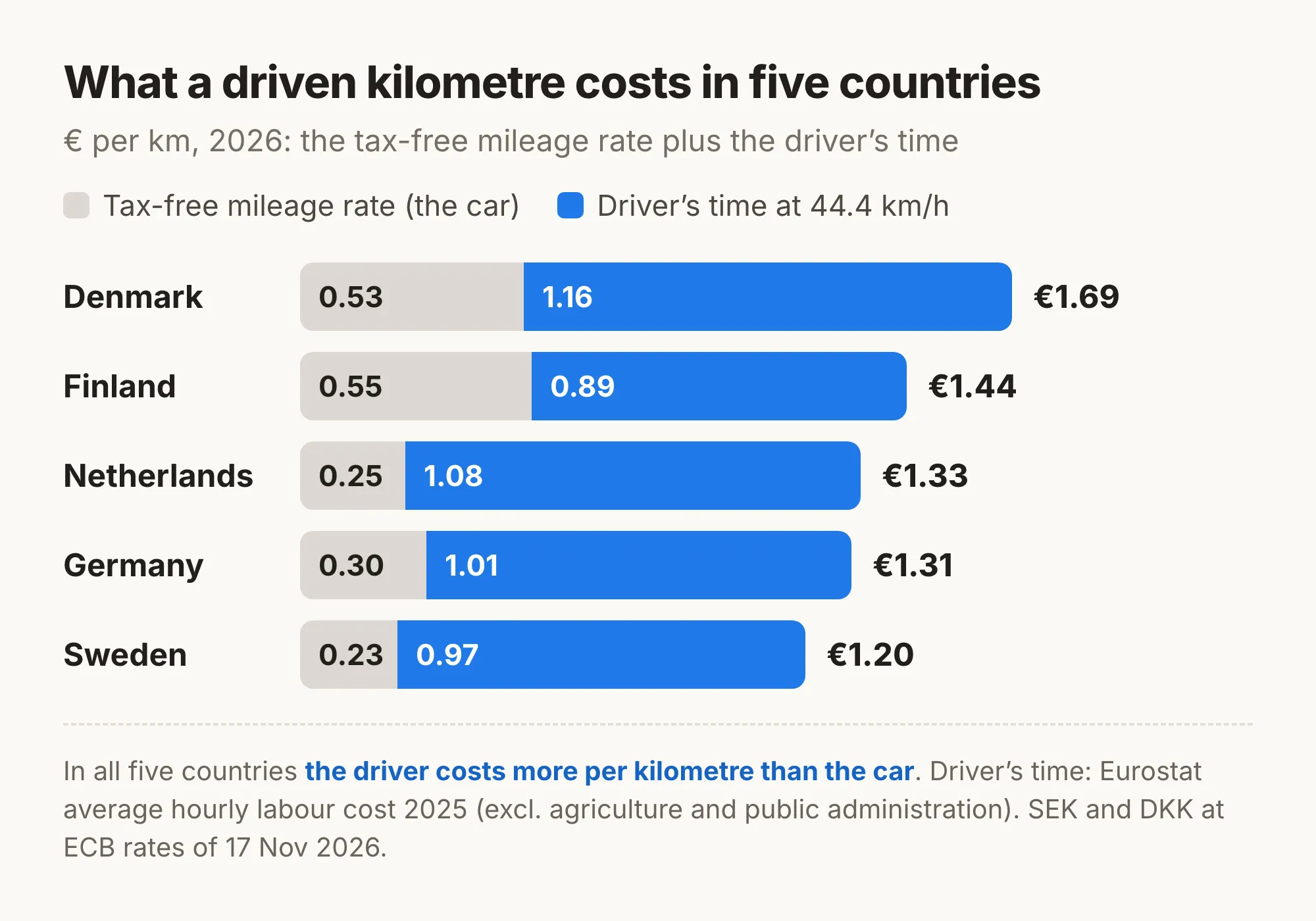
In all five countries the driver costs more per kilometre than the car: 62% of the total in Finland, and around 80% in Sweden and the Netherlands, where the mileage rate is low. The order also changes. Finland has the most expensive diesel, but Denmark has the most expensive kilometre, because Danish labour costs about 30% more than Finnish.
Eurostat’s figure covers the whole economy apart from agriculture and public administration. A technician or driver may cost less: Eurostat’s figure for transportation and storage is lower in each of the four countries here that report it. Our Finnish example uses €30 an hour (a €22 wage plus the employer’s pension and health insurance contributions and holiday pay), which gives €0.68 per kilometre. The conclusion doesn’t change: the driver is still the biggest cost.
Finland in detail: a van’s own costs
A mileage rate is a yardstick for a car. For a company van, the vehicle’s costs have to be added up. In Finland, with diesel at €2.49 a litre (the October average):
- Diesel at 9 litres per 100 km: about €0.22 per km.
- Servicing: about €0.03 per km, according to a Finnish haulage cost calculation (KTK).
- Leasing: a €30,000 van leases for about €520–580 a month. Driven 2,500 km a month, that’s about €0.22 per km.
That comes to about €0.47 per km before insurance and vehicle tax. With the driver at €30 an hour, a van kilometre costs about €1.15 before insurance and vehicle tax. In KTK’s 2022 calculation, driver pay was the largest single cost of running a van, about 39% of the total, because the total also counts overheads and time not spent driving.
What wasted kilometres cost in a year
A wasted kilometre doesn’t cost the full price per kilometre. The lease and the insurance are paid whether the van moves or not. What grows with distance is fuel, servicing and the driver’s time. In Germany, that’s about €0.20 + €0.03 + €1.01, or €1.24 per kilometre; in the Netherlands, about €1.31.
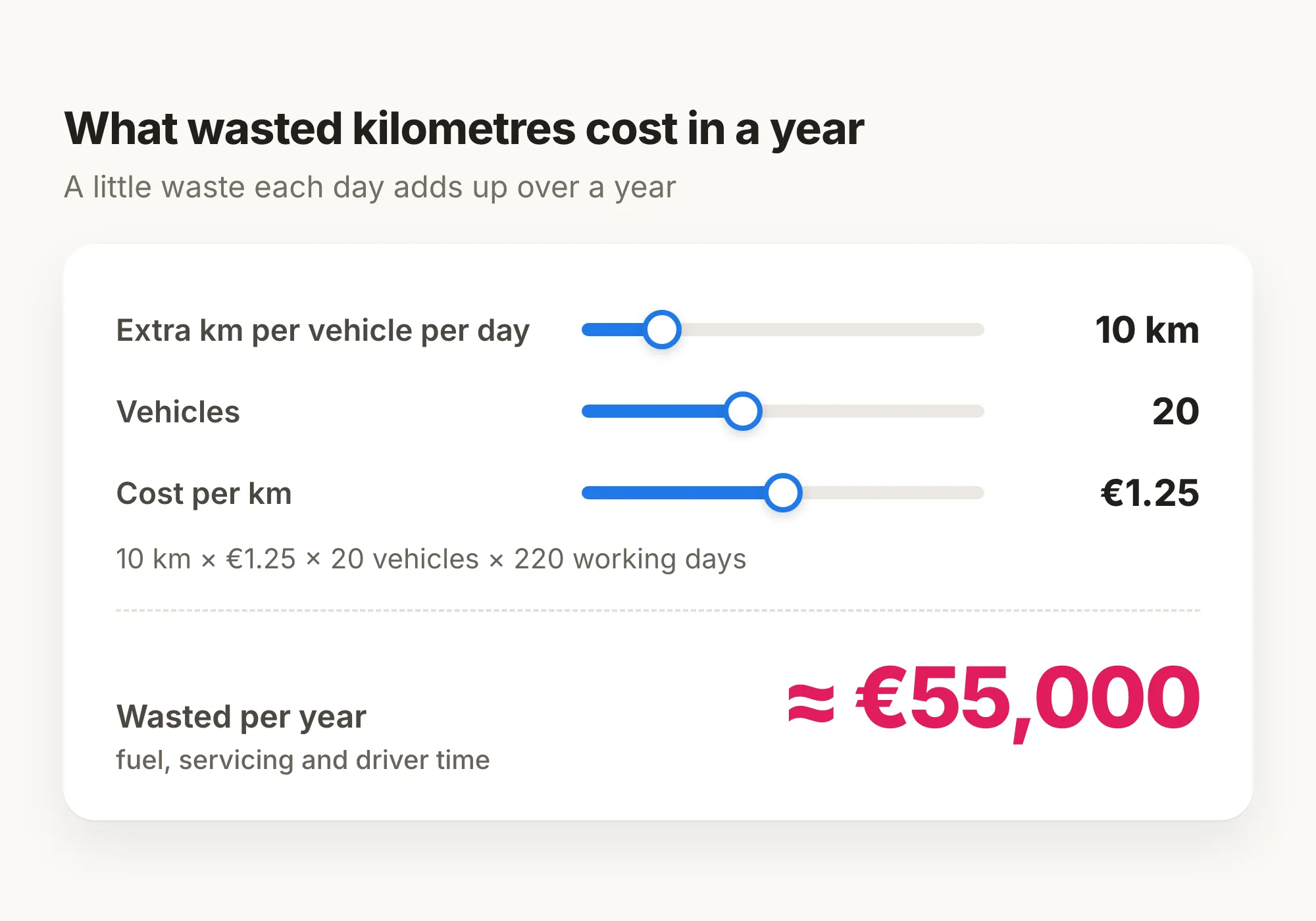
An example: if each vehicle drives 10 km a day more than it needs to, at €1.25 a kilometre, that’s €12.50 per vehicle per day. With 20 vehicles and 220 working days, it comes to about €55,000 a year.
The Finnish service day from earlier shows it in practice. It was planned first by hand and then with Allocator. For the same jobs, the optimized plan cut driving by 225 km (613 → 388 km) and time on the road by 4.2 hours (13.8 → 9.6 h).
| Saving in one day, Finnish costs | Calculation | € |
|---|---|---|
| Fuel and servicing | 225 km × €0.25/km | about 56 |
| Drivers’ time on the road | 4.2 h × €30/h | about 126 |
| Total | about 180 |
Repeated on 220 working days, that would be about €40,000 a year. The lease doesn’t shrink straight away, but fewer kilometres show up in mileage limits and in how long a van lasts. That still leaves out the biggest gain: on the same day, the work needed 9 shifts instead of 12. The freed shifts can go to new, billable work.
How to drive fewer kilometres
A business can’t do anything about the price of diesel. It can do something about how many kilometres it drives each day. Many wasted kilometres are built in at the planning stage.
- Track kilometres per job. Total kilometres grow as the work grows, but kilometres per job tell you whether the planning is efficient.
- Plan everyone’s day together. When each technician plans their own route, two vehicles easily end up in the same area.
- Take time windows and skills into account when planning. Otherwise a vehicle has to go back to the same site or cross town in the middle of the day.
- Re-plan the day when it changes. A sick call or an urgent job shouldn’t break every route in the day.
With ten or twenty people in the field, this is hard to do by hand, because there are millions of options. More on that in When do Excel and Google Maps stop working for route planning?
Work out your own saving
What do your wasted kilometres cost? The savings calculator gives an estimate from a few numbers. For a more precise answer, try Allocator free with your own jobs: import one day’s work from a spreadsheet and compare the optimized plan with the kilometres you actually drove.
